You Probably Didn't See It Either. That's Exactly the Point.
By: Christopher Henze


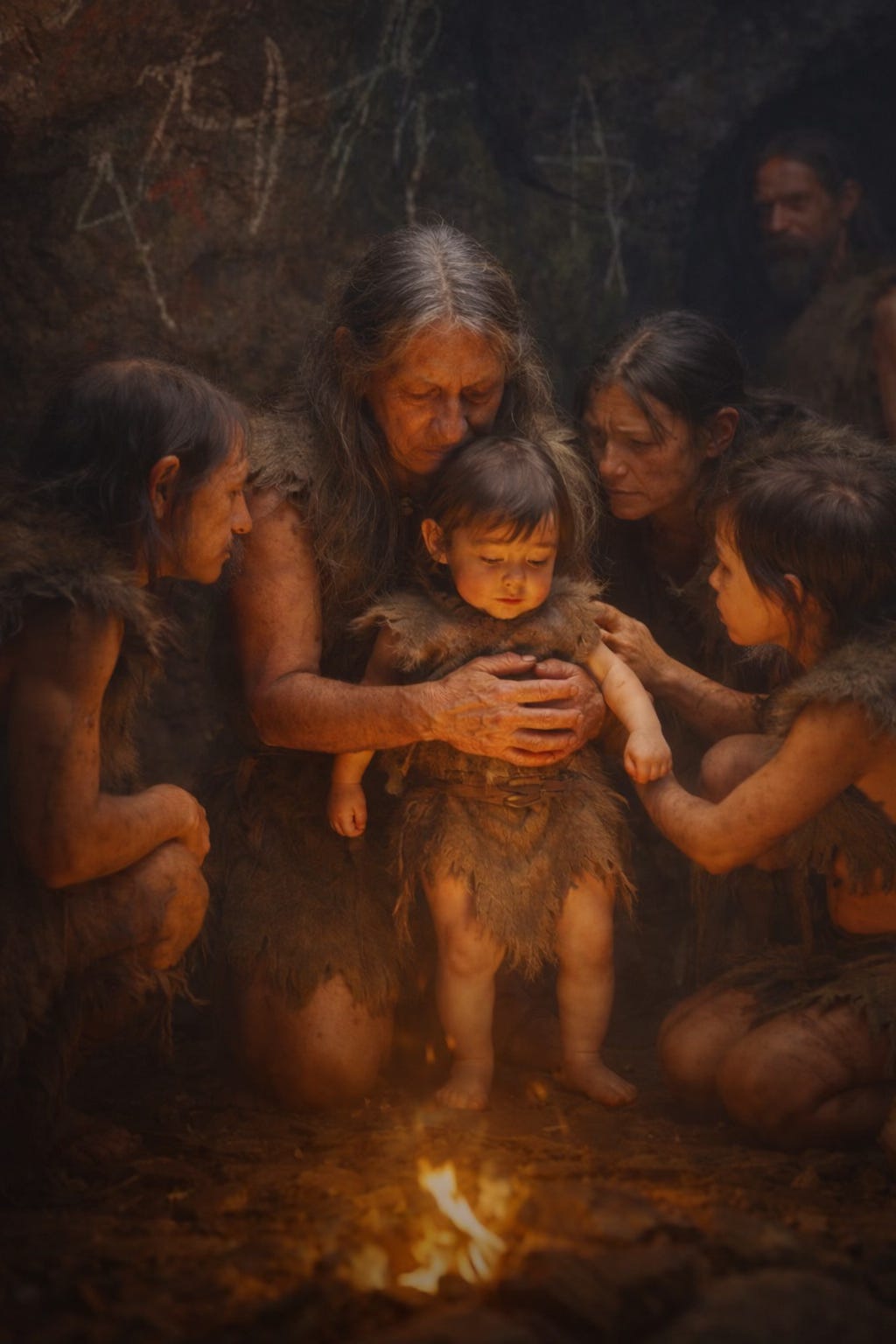
The image for this article is a beautiful rendering, warm, communal, emotionally resonant. Early humans gathered around a child in need, hands reaching in, faces full of care. The headline tells us this is evidence that Neanderthals supported disabled children despite brutal environmental conditions. It’s the kind of image that makes you feel something good about our species, about our long history of compassion, about the deep roots of human decency.
If you could, look again.
Who is at the center? Who is the primary caregiver in this image meant to illustrate ancient communal care? Who is rendered large, dominant, front and forward, hands on the child, face illuminated?
A man. A big, bearded man.
Because of my work, I caught it immediately. It’s not that I’m smarter or more perceptive, but because making our documentary Wise Women: Humanity’s Untold Origins trained me to see it. Spending years deep in the science of women’s evolutionary role, and then making the deliberate choice to put women forward in every single image we created for the film, rewired how I look at visual representations of our past. I now notice the default almost on reflex. But I remember what it felt like before that. I remember looking at images like this one and feeling the warmth and moving on, the man at the center no more remarkable than furniture.
Here is what makes this particular error so striking. The science this image is trying to illustrate is, at its core, about women. The Wise Woman Hypothesis, the evolutionary argument that post-menopausal women were central to human survival, all of it points to older females as the ones who held communities together, cared for children, freed up younger mothers, and passed down the knowledge that kept our species alive. The communal care this image is celebrating? That was largely women’s work. That was grandmother’s work. That was the work of wise women who had moved beyond reproduction and into something larger.
And yet when an artist, or more likely an AI trained on centuries of male-centered imagery, was asked to visualize that care, a man appeared at the center. Automatically. Without anyone stopping to notice. The science got swapped out for the story we already knew, the one we’ve been telling so long we’ve stopped recognizing it as a choice.
This is what gaslighting at a cultural scale looks like. Not one person pulling you aside and telling you that you’re crazy or wrong or too much. Just the slow, patient accumulation of images and stories and headlines and paintings and movies and textbooks, all of them quietly insisting that men are the protagonists of human history, even the chapters that were actually written by women. You absorb it. You stop questioning it. You look at a picture of a man cradling a child and you think, yes, that looks right, and you move on.
And then one day something shifts. You see the image again and you feel a flicker of something you can’t quite name. A wrongness. A little alarm going off somewhere underneath the years of conditioning. And if you’re a woman, there’s a decent chance you’ve been taught to distrust that alarm. To wonder if you’re being too sensitive. To ask yourself whether the anger rising in your chest is reasonable or whether you’re, once again, making too much of something.
An idea. That anger is not the problem. That anger is your nervous system working exactly as it should. It is your inner truth-teller refusing to be overwritten one more time. It is the part of you that still knows the difference between what is real and what has been handed to you as real. That distinction matters enormously, and protecting it is not hysteria. It is clarity.
The feeling that something is off, that the world is slightly tilted in a direction that keeps costing you something, that feeling is not you being crazy. It is you being awake in a world that is genuinely, demonstrably, still getting the story wrong. Women aren’t imagining the erasure. It is right there in an AI-generated image about Neanderthal grandmothers, with a man at the center.
When we made Wise Women: Humanity’s Untold Origins, we made a decision. Every image of our ancient past in that film puts women forward. Not as background figures. Not as soft shapes gathered at the edges of the frame while a man does the important thing in the center. Front. Present. Dominant in the frame. Because that is where the science actually places them, and because someone has to start making images that match the truth. We wanted audiences to feel, maybe for the first time, what it looks like when the visual story and the real story are finally the same.
If you haven’t seen it yet, we would love for you to. Wise Women: Humanity’s Untold Origins is available to rent right now at bingeable.net. Watch it with someone you love. Watch it with someone who needs to see women at the center of the human story. Watch it and let it do what we hoped it would do, rewire, just a little, the present to what feels normal.
So what do we do with that anger? We don’t swallow it. We don’t perform our way past it into something more palatable. We also don’t just let it spin in place, burning energy without direction, because that’s exhausting and the world does not need more exhausted women. We use it. We let it sharpen our eyes so we start catching these things in real time. We let it fuel the conversations we’ve been putting off. We let it push us toward the work, the community, the sustained and organized pressure that actually moves things.
Your anger is not the problem. The crazy-making is the problem. And once you can see the difference, you cannot unsee it. Just like that man at the center of an image that was always supposed to be about her.
Here, fixed it :)